
Mechanical testing of textiles and personal protective equipment (PPE): tear, abrasion, elongation, and puncture
-
 State-of-the-art equipment for testing textiles and personal protective equipment (PPE)
 -
The measurement accuracy complies with the requirements of the DSTU series of standards. EN ISO 9073, DSTU EN ISO 13935, DSTU ISO 13937, DSTU EN ISO 13934 and etc.
-
Computer registration of results
-
Fast execution of work and provision of protocols
-
Competitive prices, no middlemen
Competent authorities

Leave a request for a consultation
Describe your request and our specialist will contact you shortly to provide detailed advice on certification, conformity assessment or product labeling in accordance with Ukrainian and EU requirements.
Mechanical testing of textiles and PPE: tear, abrasion, elongation, and puncture
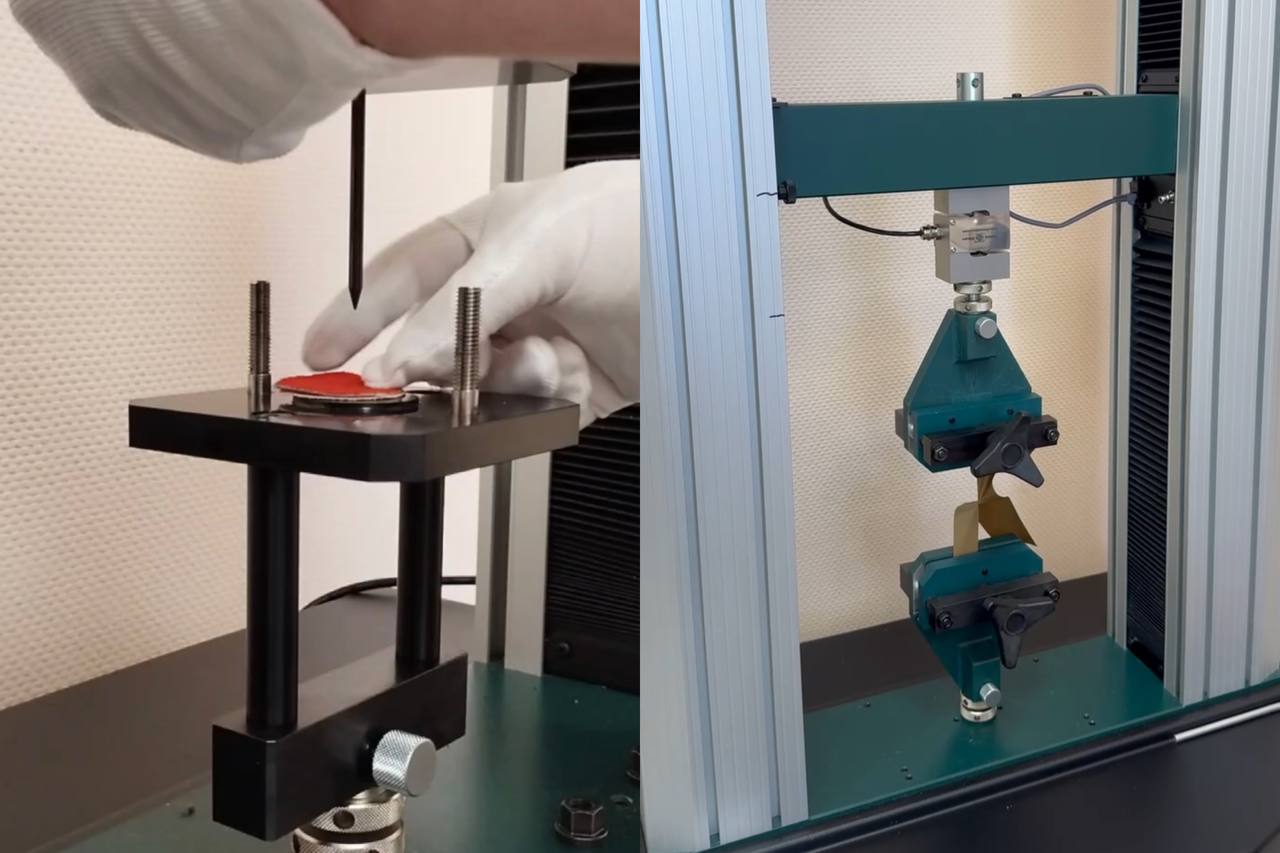
We conduct mechanical tests of fabrics, materials, and personal protective equipment (PPE) for compliance with the requirements of a series of standards, including DSTU EN ISO 9073, DSTU EN ISO 13935, DSTU ISO 13937, DSTU EN ISO 13934, etc. for strength, elasticity, and wear resistance. The tests allow us to assess product quality, guarantee safety of use, and confirm compliance with technical regulations.
Main types of mechanical tests:
Puncture test:
- – Assessment of resistance to puncture by sharp objects (relevant for PPE — gloves, protective clothing, footwear);
- – Determination of maximum load before damage.
Випробування на розрив:
- – Визначення міцності матеріалу при розтягуванні до розриву;
- – Оцінка граничного навантаження і подовження.
Tear test:
– Іsimulation of mechanical impact that may cause damage under operating conditions;
– Assessment of the stability of seams and edges of the product.
Elongation test:
- – Analysis of deformation properties (how elastic or rigid the material is);
- – Important for fabrics that need to perform in dynamic conditions.
We accept samples from manufacturers, trading companies, importers, and certification bodies.
Advantages of the laboratory
Testing laboratory ТОВ “АКАДЕМТЕСТ”

Accreditation, advanced equipment with extensive capabilities for testing, verification, and control of numerous safety parameters
Advanced testing and inspection methods in accordance with current standards and regulations, innovative techniques, and optimal solutions
Experienced experts, technical specialists, and engineers, highly qualified specialists in the team
Affordable testing prices, no middlemen
Prompt testing and rapid receipt of reports
Experience and reputation that guarantee objective, unbiased, and realistic test results
Testing standards
Tests are conducted in accordance with Ukrainian and international standards, in particular:
- DSTU EN ISO 13934, 13937, 9073, 863, 12236 Test methods for textile materials;
- DSTU EN 388, EN ISO 13688, EN 420 (EN 388:2016, IDT) Protective gloves for protection against mechanical damage (for protective gloves, clothing, coveralls, etc.);
- Technical regulations for personal protective equipment, approved by Resolution of the Cabinet of Ministers of Ukraine No. 761 dated August 27, 2008;
- Industry-specific technical specifications (technical conditions) of the Customer, if necessary.
Based on the test results, we provide a test protocol.
Video and cost of testing
The cost of work in each specific case is calculated separately depending on the selected test methods, the type and complexity of the tests, the number of samples, and other factors.
Contact us in any convenient way or write directly to the Provider:
All Technical Regulations according to which we conduct tests
Aerosol sprayers
Technical regulations for aerosol dispensers (Resolution of the Cabinet of Ministers of Ukraine No. 154 dated February 21, 2023)Explosive environments and industrial equipment for explosion protection
Technical regulations for equipment and protective systems intended for use in potentially explosive atmospheres (Resolution of the Cabinet of Ministers of Ukraine No. 1055 dated December 28, 2016)Measuring equipment and weighing
Technical regulations for non-automatic weighing instruments (Resolution of the Cabinet of Ministers of Ukraine No. 1062 dated December 16, 2015) Technical regulations for measuring instruments (Resolution of the Cabinet of Ministers of Ukraine No. 163 dated February 24, 2016) Technical regulations for legally regulated measuring instruments (Resolution of the Cabinet of Ministers of Ukraine No. 94 dated January 13, 2016)Electrical and electronic equipment
Technical regulations for low-voltage electrical equipment (Resolution of the Cabinet of Ministers of Ukraine No. 1067 dated December 16, 2015) Technical regulations on electromagnetic compatibility of equipment (Resolution of the Cabinet of Ministers of Ukraine No. 1077 dated December 16, 2015) Technical Regulation on Restrictions on the Use of Certain Hazardous Substances in Electrical and Electronic Equipment (Resolution of the Cabinet of Ministers of Ukraine No. 1057 dated December 3, 2008)Railway transport
Technical regulations for railway transport infrastructure safety (Resolution of the Cabinet of Ministers of Ukraine No. 494 dated July 11, 2013) Technical regulations for the safety of rolling stock in railway transport (Resolution of the Cabinet of Ministers of Ukraine No. 1194 dated December 30, 2015)Personal protective equipment
Technical regulations for personal protective equipment (Resolution of the Cabinet of Ministers of Ukraine No. 771 dated August 21, 2019)Civil protection measures
Technical Regulations for Civil Protection Equipment (Resolution of the Cabinet of Ministers of Ukraine No. 535 dated May 26, 2023)Machinery and equipment
Technical regulations for machine safety (Resolution of the Cabinet of Ministers of Ukraine No. 62 dated January 30, 2013) Technical regulations for noise emissions into the environment from equipment used outside premises (Resolution of the Cabinet of Ministers of Ukraine No. 1186 dated December 4, 2019)Medical devices and diagnostics
Technical regulations for medical devices (Resolution of the Cabinet of Ministers of Ukraine No. 753 dated October 2, 2013) Technical regulations for in vitro diagnostic medical devices (Resolution of the Cabinet of Ministers of Ukraine No. 754 dated October 2, 2013)Equipment operating under pressure
Technical regulations for pressure equipment (Resolution of the Cabinet of Ministers of Ukraine No. 27 dated January 16, 2019) Technical regulations for simple high-pressure vessels (Resolution of the Cabinet of Ministers of Ukraine No. 1025 dated December 28, 2016)Fuel and energy
Technical regulations regarding requirements for automotive gasoline, diesel, marine and boiler fuels (Resolution of the Cabinet of Ministers of Ukraine No. 927 dated August 1, 2013) Technical regulations regarding requirements for liquefied gas for motor transport, municipal and domestic consumption, and industrial purposes (Resolution of the Cabinet of Ministers of Ukraine No. 667 dated July 29, 2020)Lifting equipment
Technical regulations for elevators and safety components for elevators (Resolution of the Cabinet of Ministers of Ukraine No. 438 dated June 21, 2017)Household chemicals (detergents)
Technical regulations for cleaning products (Resolution of the Cabinet of Ministers of Ukraine No. 717 dated August 20, 2008)Radio and electronic equipment
Technical Regulations for Radio Equipment (Resolution of the Cabinet of Ministers of Ukraine No. 355 dated May 24, 2017)Agriculture and timber industry (tractors)
Technical regulations for the type approval of agricultural and forestry tractors, their trailers and interchangeable towed machinery (Resolution of the Cabinet of Ministers of Ukraine No. 1367 dated December 28, 2011) Technical regulations regarding components and characteristics of wheeled agricultural and forestry tractors (Resolution of the Cabinet of Ministers of Ukraine No. 1368 dated December 28, 2011)Heating equipment
Technical regulations for water heating boilers operating on liquid or gaseous fuel (Resolution of the Cabinet of Ministers of Ukraine No. 748 dated August 27, 2008) Technical regulations for gas-fueled appliances (Resolution of the Cabinet of Ministers of Ukraine No. 814 dated July 4, 2018)Based on the test results, we provide a TEST PROTOCOL
It contains the following information:
- Name and details of the testing laboratory (including accreditation);
- Protocol number and date of compilation;
- Information about the customer who ordered the tests;
- Product name;
- Product type, model, serial number;
- Manufacturer and/or supplier;
- Date of sample receipt by the laboratory;
- Name of the technical regulation or standard according to which the test is conducted;
- List of methods and standards used;
- Test conditions (temperature, humidity, voltage, etc.);
- Measuring instruments (with calibration specifications);
- Detailed data for each test item;
- Measured actual values and their comparison with acceptable standards;
- Comments or observations (if any);
- Overall test result (complies/does not comply with requirements);
- Comments or recommendations (if any);
- Signature(s) of the responsible person(s) and stamp (if applicable).




Industry


We have prepared answers to frequently asked questions from customers.